
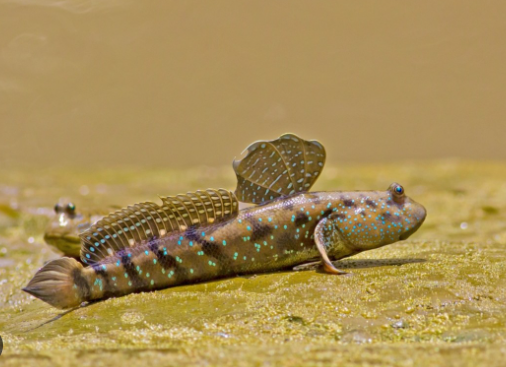
Mudskippers are fascinating creatures that defy expectations with their unique ability to venture onto land. These amphibious fish, found primarily in intertidal zones, have adapted remarkably to both aquatic and terrestrial environments. In this post, we’ll explore the reasons behind their land-walking habits and the adaptations that make it possible.
1. Evolutionary Adaptations for Land
One of the primary reasons mudskippers can walk on land is their evolutionary adaptations that facilitate a semi-terrestrial lifestyle. Unlike most fish, mudskippers have evolved robust pectoral fins that allow them to “walk” in a manner reminiscent of a seal or a sealion. These adaptations include a wide, flat shape and increased musculature, enabling them to push themselves off the ground effectively. As a result, they can traverse mudflats and mangroves in search of food or a mate.
Not only do these adaptations help in mobility on land, but they also assist in other essential activities. For example, mudskippers use their fins to dig burrows where they can hide from predators and store moisture, a critical survival tactic in their harsh environment. This adaptation showcases their resilience and evolutionary success in transitioning between water and land environments.
-
- Observe mudskippers in their natural habitat to see their walking techniques.
-
- Research the anatomy of mudskippers to understand their unique adaptations.
-
- Consider how other species might adapt similarly to their environments.
-
- Explore local ecosystems to witness evolutionary diversity.
2. Behavioral Strategies for Survival
Mudskippers are not just walking for the sake of it; their behavior is intricately linked to survival strategies. Moving onto land allows them to escape aquatic predators and reach food sources like insects and algae found in the mud. Additionally, this behavior aids in thermoregulation, as they can bask on the hot mudflats to raise their body temperature, which is vital for their metabolism.
Moreover, mudskippers have developed social behaviors that are enhanced by their ability to be on land. They often engage in displays where they puff up their bodies and perform various movements to attract potential mates. This terrestrial display contributes to their reproductive success, showcasing the critical role land-walking plays in their lifecycle and population sustainability.
-
- Observe social behaviors and mating displays in mudskippers.
-
- Learn how different environmental factors affect their feeding habits.
-
- Examine how mudskippers manage threats both in water and on land.
-
- Consider how climate changes impact their ecosystems and behaviors.
3. Environmental Influences on Movement
The habitats where mudskippers thrive—typically mangrove swamp areas and muddy shores—influence their need to walk on land. These regions are characterized by fluctuating tide levels, meaning that even though mudskippers are aquatic creatures, they often find themselves stranded during low tides. Walking on land becomes a necessary adaptation for survival during these times, allowing them to find refuge in burrows or scavenge for food.
Additionally, environmental conditions such as salinity and temperature further dictate their movement patterns. Mudskippers prefer specific salinity ranges in their habitat, and when water levels fall, they can migrate to smaller puddles or moist areas by walking. This behavior highlights their resilience and adaptability to changing environmental conditions, which is crucial for their survival.
-
- Research your local intertidal ecosystems to understand mudskippers’ habitats.
-
- Monitor tide schedules to see mudskippers’ activity patterns.
-
- Investigate how climate change affects intertidal zones.
-
- Engage in conservation efforts to protect these crucial habitats.
In conclusion, mudskippers are extraordinary examples of evolutionary adaptation, showcasing how animals can thrive in diverse environments. By understanding their unique behaviors and adaptations, we can appreciate not only the mudskipper’s resilience but also the importance of preserving their habitats. Next time you find yourself near an intertidal area, take a moment to observe these fascinating creatures in action!