
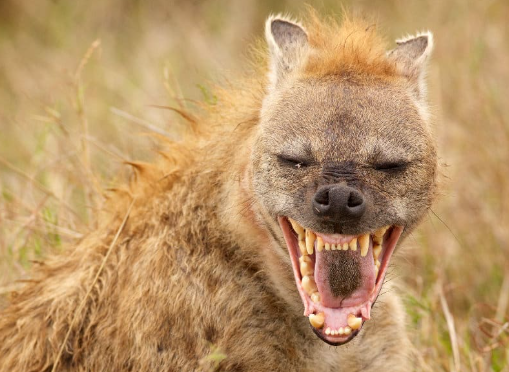
Hyenas are often misrepresented as the ultimate villains of the animal kingdom, but their laughter holds a fascinating significance. Far from being a sign of amusement, the sounds they produce reveal crucial information about their social structure and emotional state. Let’s explore why hyenas “laugh” and what it means.
1. Understanding Hyena Communication
Hyenas have a complex system of vocalizations, and what appears to be laughter is actually a form of communication. Known as “whoops,” “grunts,” and “giggles,” these sounds serve various purposes, including signaling excitement or distress. For example, when food is nearby, hyenas might emit these “laughs” to let others know of their location, acting as an alert for both friends and competitors.
This vocal versatility is crucial for their social interactions. Depending on the context, the same sound can communicate different emotions or intentions. For instance, a young hyena’s laugh might indicate playfulness, whereas an adult’s can signal aggression or dominance. Understanding these nuances helps researchers and enthusiasts alike grasp the dynamics of hyena society.
-
- Observe hyena sounds in their natural habitat.
-
- Learn about their different vocalizations for better interpretation.
-
- Note the context of the “laugh” to understand its meaning.
-
- Consider using audio resources to familiarize yourself with hyena calls.
2. The Role of Social Hierarchy
The structure of hyena social groups, known as clans, plays a significant role in their communication methods, particularly their laughter. Within these clans, a clear hierarchy exists, often dominated by female hyenas. When members of different social ranks interact, their vocalizations can reflect their status. A low-ranking member might use laughter to show submission, while higher-ranking individuals might use it to assert dominance.
This social complexity is enhanced during cooperative hunting or feeding scenarios. Laughter can serve as an indication of social bonds, helping ensure the clan operates cohesively. By laughing, hyenas can communicate their emotional state, influencing their interactions and reinforcing social ties. Thus, the “laugh” is not only a form of communication but a cohesive force that binds the clan together.
-
- Observe the interactions within a hyena clan.
-
- Research the roles of male and female hyenas in social structure.
-
- Take note of vocalizations used during group activities.
-
- Learn about differences in behavior based on rank within the clan.
-
- Understand how hierarchy affects group dynamics and decision-making.
3. Emotional Context and Behavior
Hyenas are known to express a range of emotions, and their laughter can indicate feelings beyond mere excitement. For example, laughing might occur during play, a crucial element for young hyenas learning social skills. However, distress can also trigger similar sounds, blurring the line between joy and anxiety. Recognizing this emotional context is essential for researchers studying their behavior.
Moreover, this complexity allows hyenas to respond to various environmental stimuli, such as the presence of predators or the discovery of a carcass. Their laughter serves as a cue to establish emotional states among clan members, allowing for better coordination during stressful situations. Ultimately, the laughter of a hyena can be a reflection of intricate emotional lives much different from the simplistic views often held.
-
- Recognize laughter as a multi-faceted form of expression.
-
- Monitor how emotions play a role in hyena interactions.
-
- Observe behaviors during play and competition for a deeper understanding.
-
- Consider how environmental factors impact their emotional responses.
4. Conservation and Misunderstandings
Despite their complex social structures and emotional profundity, hyenas often face misconceptions. Many people associate their laughter with a lack of intelligence or malicious intent. In reality, hyenas are highly social and possess advanced cognitive abilities, vital for their survival in harsh environments. Conservation efforts are increasingly focused on changing public perceptions while protecting these misunderstood creatures.
Educational programs and wildlife conservation initiatives seek to highlight the ecological importance of hyenas. They play essential roles as scavengers and are integral to maintaining healthy ecosystems. Misinterpretation of their vocalizations can lead to unjustified fears or lack of support for conservation measures, further jeopardizing their existence in the wild.
-
- Engage in local conservation efforts focused on hyenas.
-
- Share factual information about hyenas to correct misconceptions.
-
- Participate in educational programs to learn more about their habitat.
-
- Encourage friends and family to appreciate wildlife diversity.
Hyenas are fascinating creatures whose laughter reflects a complex emotional and social landscape. Understanding their vocalizations not only deepens our appreciation for these animals but also underscores the importance of protecting them. Take a moment to explore how you can contribute to conservation efforts and support the preservation of wildlife. Every action, no matter how small, makes a difference!